On Patterns 1
Pentatonic Pattern Exploration
The primary way I practice is by establishing a pattern, and moving that pattern throughout the range of my instrument. In contrast to a guitar player moving a chord shape or melodic line up a fret, the woodwinds each present a unique challenge in accomplishing this: each note feels somewhat unique to play, and therefore the shapes that emerge from connecting notes will feel unique. In this post, I will share one of my favorite pattern explorations, and provide a downloadable pdf where you can dig in a bit deeper.
I can't take credit for this exercise, as I learned it from Ben Wendel through an interview with Jay Metcalf. Ben learned it from someone who learned it from someone. This is a pattern exploration exercise that relies on scale patterns and, while any scale will do, for demonstration we will use the G pentatonic scale.

Figure 1, a G pentatonic scale
I like the G pentatonic because the scale falls over the clarinet break and targets the throat tones of the clarinet as well. For this specific exploration, we are combining patterns from G pentatonic with the pentatonic scale one-half step above, the Ab pentatonic.

Figure 2, an Ab pentatonic scale
We use segments from the ascending G pentatonic scale (Figure 1) and combine them with the corresponding segment from the descending Ab pentatonic scale (Figure 2). In Figure 3.1, we begin by ascending the first two notes of the G pentatonic, then descending the first two of the Ab pentatonic.

Figure 3.1, combine the first two notes of G pentatonic with the first two notes of Ab pentatonic.
You can then repeat this ascending and descending pattern to turn it into a true exercise, as in Figure 3.2

Figure 3.2, adding a repeat
As you move through this pattern, go slowly and make sure you are maintaining the same quality of embouchure throughout, as well as maintaining good left index finger position. Repeat each exercise for as long as possible- use a full breath. You may continue to add scale degrees, but remember to add equal degrees from each scale used. These are written out on the next page.
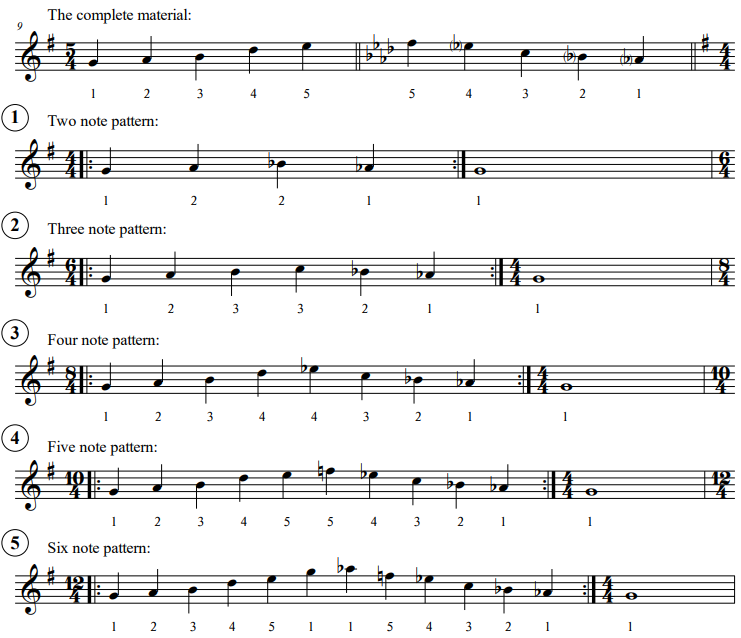
Page 2 of the pdf includes this series of exercises.
The first pattern (exercise 1) targets your throat tones and left index finger position. Exercise 2 targets crossing the break, and can have the added challenge of changing between left-hand B/right hand C and right-hand B/left hand C. Subsequent exercise expands the challenge of maintaining proper voicing and tone matching.
The downloadable pdf features in-depth explanations of each step in the process and a way to “level up” the difficulty on Page 3.