Transcription 1
I’ve been fascinated by clarinet cadenzas from an early age. I remember being 12 or 13 and learning the second movement of Mozart’s Clarinet Concerto, the Adagio. In that movement, I was struck by where I played all by myself:
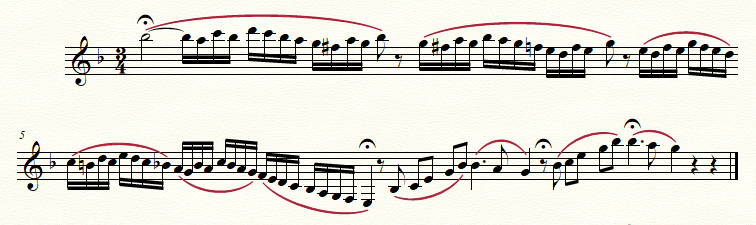
Mozart Concerto K.622 Movement 2 Cadenza
The music still made sense, even though there were no chords from the piano with me. How did that work? I was discovering how to relay harmony through melody.
I will be posting my analysis (written in Bb instrument speak) of two modern cadenzas from one of my favorite clarinetists: Felix Peikli (https://www.kingclarinet.com/), from two of his recordings: Midnight Sun (from It’s Showtime! Live) and Dark Voyage (from Royal Flush). I hope this offers insight into how musicians analyze and think about transcriptions to distill the essence of another musician’s sound and explore and understand it. The first step, which has already been done in this case, is to listen and learn the notes. I memorized the notes here and learned them in a couple of keys to understand the sound before writing down the transcription. Remember, the first steps are always to listen, learn, and memorize. The last step is to write down.
We’re starting with Cadenza 1 - Midnight Sun (youtube)
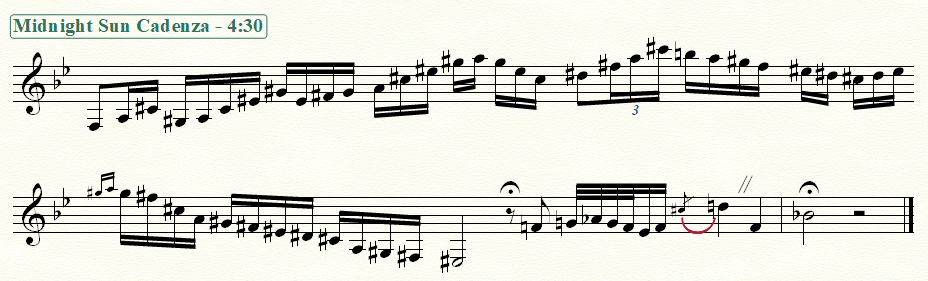
This can be heard in the recording around the 4:30 mark.
I think Felix would consider himself to be, at the very least, heavily influenced by jazz language, so I’ll be analysing this through that lens. His improvisational style in these cadenzas leans into augmented harmonies, characterized by a raised 5th sound. This is important for my analysis of Midnight Sun, the raised 5th can be enharmonically spelled as a lowered 6th.
There is one crystal clear signal as to what scale this cadenza may be leaning on to communicate its harmony. At the tail end of the first line of the written transcription, there is this scale:
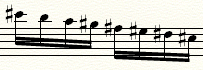
Put that way, it looks like a C# mixolydian b6 scale. The mixolydian scale has a lowered 7th note, and when you add a lowered 6th, it takes on more of a minor quality due to the scale’s relationship (the 5th mode) to the melodic minor scale (also known in this context as the jazz minor scale).
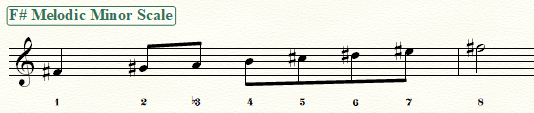
The melodic minor scale is rich in harmonies, including two minor triads, two major triads, two diminished triads, and an augmented triad.

The scales’ tetrachords (4 note arpeggios) are also rich, and here we start to see some of the ambiguity that this scale gives us to float around before our final cadence at the end of the cadenza.

First, we want to consider why this scale is being used at all when Midnight Sun is in Bb major. A traditional II V I cadence in Bb is the following:

We can look at the Cm7 and simply substitute it with the first tetrachord from our F# melodic minor scale, F#m(maj7):

We can see how much more chromatic the voice leading is with the F#m(maj7) compared to the Cm7. We can also identify the augmented triad in F#m(maj7) by looking at A, C#, and E#. This opens up the chord and adds to the ambiguity of the harmony, being the source of the floating quality of the cadenza overall. We get a lot of the same sounds with the C#7, and seeing as the G# is easily replaced by the A (the b6 of F# melodic minor), we get a connection between the V and I of our melodic minor. Felix alternates between the F#m(maj7) and C7(#5) continuously over the cadenza, using the G# and neighboring A to reach for that augmented, dreamy sound:
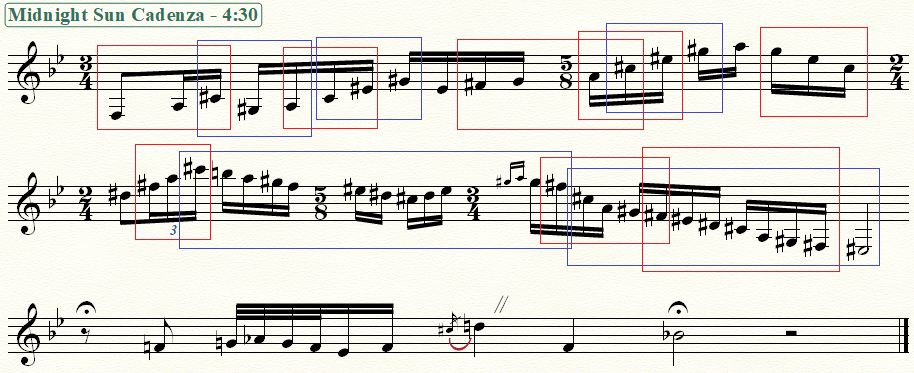
Red is F#m(maj7) chord tones, blue is C#7 and C#7(#5) tones. Some aren’t even marked, but every note in this is taken directly from our melodic minor scale. The ambiguity (I’ve been using that word a lot) allows this to gently land onto the E# of our C# mixolydian b6 scale, which is, of course, shared with the root of our V7, leading to a beautiful cadence at the end.
I hope this helps open your mind to thinking critically about music, transcribing something you enjoy the sound of, and using your theory brain to consider how you might approach practicing and exploring it. I’m in the process of exploring this sound myself, and I may write down and share some exercises I’ve been working on to help me do so.
Cheers, and please reach out if you have any thoughts!
Next time: Dark Voyage (youtube)